|
|
|
Jaiselmer
The Glory of the Golden Fort

Rising from the heart of the
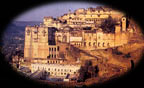
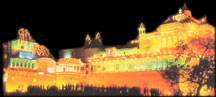
Thar desert like a golden mirage is the city of Jaisalmer. A commanding fort
etched in yellow sandstone stands with all its awesome splandour, dominating
the amber - hued city. The city has an interesting legend associated with
it, according to which, Lord Krishna foretold that remote descendents of his
clan would build his kingdom atop the triangular hill. His prophecy was
fulfilled in 1156AD.
|
|
When
Rawal Jaisal,
a descendent of his clan founded Jaisalmer, perched on triangular hill. Rulers
of Jaisalmer were feudal chiefs who lived off the forced levy on the
caravans
laden with precious silks and spices
that crossed the territory enroute Delhi or Sind. These caravans earned the
town great wealth. For years Jaisalmer remained untouched by the outside
influences. The rise of shipping trade and the port of Mumbai saw the the
decline of Jaisalmer. But the desert fortress that seems to be straight out
of the "Tales of the Arabian Nights", still enchants. Life inside the
citadel conjures up images of medieval majesty visible in its narrow lanes
strewn with magnificent palaces, havelies, temples and of course skilled
artisans and ubiquitous camels. The setting sun turning Jaisalmer into a
beautiful golden brown is a spectacular sight.

|
Places of interest :-
Sonar Kila (Golden Fort), Gadhisar Lake, Jain Temples, Manak Chowk,
Nath Mal Ji Ki Haveli, Salim Singh Ki Haveli & Vyas Cenotaphs Excursion :-
Lodorva (16 kms) Sam Sand Dunes(45kms), Amar Sagar (5kms) Bada Bagh (6 kms)
back to top |
|
|
Jodhpur |
|
Tale of Great Heroes & Grandeur
|
|
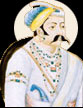
City of Jodhpur which echoes
with tales of antiquity in the emptiness of the desert is set at the edge of
the Thar desert. It was founded in 1459 AD by
Rao Jodha
- chief of the
Rathore
clan of Rajput who claimed to be
the descendents of Lord Rama - the epic hero of Ramayana. The massive 15th
century AD. Mehrangarh Fort looms on the top of a rocky hill, soaring 125
mts. above the plains. The city is encompassed by a high wall - 10 Km long
with 8 gates and innumerable bastions. |
 A major trade center of of the 16th century AD., the fortress-city of Jodhpur
is now the second largest city of Rajasthan. While graceful palaces, forts and
temples strewn throughout the city bring alive the historic grandeur, exquisite
handicrafts, folk dances, music and the brightly attired people lend a romantic
aura to the city also called "Blue City".
Life style of Jodhpur city is unusually fascinating with folks wearing
lovely multihued costumes, artistically designed. Women folk wear wide
gathered skirts and hip length jacket, with three-quarter length
sleeves, covering the front and back. Colourful turbans worn by men folk
add more colour to the city. It was from here that the popularly worn
baggy-tight, horse riding trousers -
"Jodhpurs" took their
name. Countless festivities celebrate the rich past and culture of the
former princely state. The Marwar
Festival held
annually is one such spectacular bonanza.
|
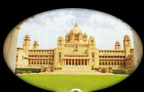
Places of interest :- Mehrangarh Fort, Jaswant
Thada (Royal Cenotaphs), Ummed Bhawan Palace, Mandore Gardens. Cenotaphs at
Mandore.
Excursion
:- Osian Jain Temple (60 kms)
back to
top |
|
Pushkar
The Blessing of Brahma ~ the creator
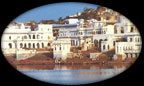
11 Km from the town of Ajmer on
the edge of the desert lies the tiny tranquil town of Pushkar along the bank
of picturesque Pushkar lake - an important pilgrimage spot for the Hindus.
The lake has a mythological significance associated with it. According to
myth
Lord Brahma
was on his way to search for a suitable place to perform a fire sacrifice.
While contemplating, a lotus fell from his hand on the earth and water
sprouted from three places one of them was Pushkar where Lord Brahma
performed his yagna or fire sacrifice.
|
|
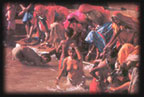 Every year
thousands of devotees throng the lake around the full moon day of Kartik (
October-November) to take a "Holy Dip"
in the lake. A huge and colourful cattle fair - the
Pushkar Fair,
is also held during this time. Dance, music and colourful shops spring up during
this fair. Also on the sale are mouth watering traditional delicacies.
Colourfully attired village folk enhance the fun of the occasion. A host of
cultural events against the backdrop of this pretty setting are also organised
including attractive puppet shows. Cattle
Auction, horse & camel
races are also a part of the festivities. Visitors can stay over night in tented
accommodation during this fair. Every year
thousands of devotees throng the lake around the full moon day of Kartik (
October-November) to take a "Holy Dip"
in the lake. A huge and colourful cattle fair - the
Pushkar Fair,
is also held during this time. Dance, music and colourful shops spring up during
this fair. Also on the sale are mouth watering traditional delicacies.
Colourfully attired village folk enhance the fun of the occasion. A host of
cultural events against the backdrop of this pretty setting are also organised
including attractive puppet shows. Cattle
Auction, horse & camel
races are also a part of the festivities. Visitors can stay over night in tented
accommodation during this fair.
Places of interest :-Savitri Temple, Brahma Temple,
Bathing Ghats, Man Mahal, Bazaars
back to
top |
|
Udaipur
Venice of the East
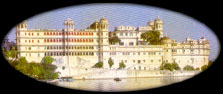
The
"City of
Lakes", Udaipur is a lovely land around the azure water lakes, hemmed in by the
lush hills of the Aravalis. A vision in white drenched in romance and beauty,
Udaipur is a fascinating blend of sights, sounds and experiences - an
inspiration for the imagination of poets, painters and writers. Udaipur is jewel
of Mewar - a kingdom ruled by the Sisodia dynasty for 1200 years. The foundation
of the city has an interesting legend with it. According to it,
Maharana Udai Singh the
founder, was hunting one day when he met a holy man meditating on a hill
overlooking the lake Pichhola. The hermit blessed the Maharana and advised him
to build a palace at this favourably located spot with a fertile valley watered
by stream, a lake, on agreeable altitude and an amphitheater of low mountains.
Maharana followed the advice of the hermit and founded the city in
1559AD.Exquisite Palaces of Udaipur, shimmering like jewel on the Lake
Pichhola is overwhelming in splandour
Places of interest :- City Palace, Jagdish Temple, Saheliyon - Ki - Bari
or Queens Garden,
Lake Pichhola , Sajjan Garh ( Monsoon Palace ) Indian Folk Art Museum,
Excursions:- Eklingji Temple( 22 Kms ) Nagda (25 kms) Haldigaghadi (40
kms) Rajsamand Lake ( 70 kms) Kumbalgarh Fort (90 kms) Jaisamand Lake (50
kms) Ranakpur Jain Temples (90 kms)
back to
top |
|
Dungarpur
The land of varied Wonders
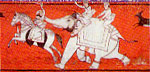
Dungarpur was
founded in 1282 AD. by Rawal Veer Singh,
when he took over this part of the state from the Bhil Chieftain Dungaria.
Dungarpur is also noted for its wildlife variety - Jackal, Jungle Cat, Indian
Fox, Hyena, Black faced monkey, Porcupine, Common Mongoose are common
inhabitants.
Gaib Sagar lake
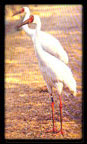
is flocked by many migratory birds during winters including Rosy Pelican, Pond
Heron, Pintail Ducks, Bittern, Saras Crane, White Necked Stork, Black Ibis, Pere
Grien Falcon, White Ibis, Lesser Flamingo, Spotted billed Pelican, Turtle Dove,
White Breasted Kingfisher, Peafowl, Indian Long Billed Vulture, Large & Cattle
Egret in all about 125 spices of birds are
found in Dungarpur. Dungarpur
is famous for its unique style of architecture as seen in its palaces and noble
residences. These royal residences are adorned by balconies built in stone in a
unique style typical of the area developed during the reign of Maharaja Shiv
Singh ( 1730 - 1785 AD.). Silver smiths of the area are famous for lacquer toys
and picture frames.
Places of interest
:-Udai Bilas Palace, Juna Mahal, Gaib Sagar Lake, Govt. Archaeology Museum
Excursions:- Baneshwar (60 kms) Deo Somnath Temple (26 kms)
back to top
|
|
Sawai Madhopur
Gateway to The Tiger
Den
Sawai Madhopur is the gateway to the
world famous & renowned
"Ranthambhor National Park".
Ranthambhor has been a witness to the rise and fall of many rulers and a series
of battle scenes.
|
|
I n 13th century AD, Govinda the grandson of Prithvi Raj Chauhan took over reign of the land.
Later his successor Vaghbhatta, beautified the city and built a
noteworthy temple at Jhain. In the middle of 15th century ad, Rana Kumbha
Captured and gifted the fort to his son, later to be occupied by the Hada
Rajput's of Bundi and then by Mughal emperor Akbar and Aurangzeb. Mughal
Emperor Shah Alam Gifted it to Maharaja Sawai Madho Singh Ist of Jaipur in
1754 and since then it was maintained as the hunting reserve of the
Maharaja. Queen Elizabeth IInd & Duke of Edinburgh
were part of the royal hunting parties who stayed here. n 13th century AD, Govinda the grandson of Prithvi Raj Chauhan took over reign of the land.
Later his successor Vaghbhatta, beautified the city and built a
noteworthy temple at Jhain. In the middle of 15th century ad, Rana Kumbha
Captured and gifted the fort to his son, later to be occupied by the Hada
Rajput's of Bundi and then by Mughal emperor Akbar and Aurangzeb. Mughal
Emperor Shah Alam Gifted it to Maharaja Sawai Madho Singh Ist of Jaipur in
1754 and since then it was maintained as the hunting reserve of the
Maharaja. Queen Elizabeth IInd & Duke of Edinburgh
were part of the royal hunting parties who stayed here.
Places of interest :- Fort, Ranthambhor National Park,
Kala Gora Bhairon Temple, Jogi Mahal
back to
top |
Shekhawati
The Open Air Art
Gallery
|
|
|
 |
|
|
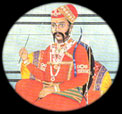
The semi desert region of Shekhawati
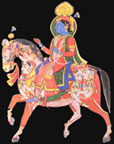
is a colourful fantasy having a fascination uniquely of its own. "The Open Air
Art Gallery" as it is popularly called, is famous for its
plethora
 of
painted havelies, all
commendable pieces of the rich artistic tradition of this region . Shekhawati
derives its name from Rao Shekha (1433 AD to
1488 AD) a scion of the
Kachhwaha family of Jaipur. Shekhawati's magnificent havelies or mansions built
by rulers, merchants of the region, display a unique architectural style that
evolve around the courtyard to ensure safety and privacy of women folk and
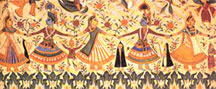
protection from the heat of long and harsh summer. The Havelies painted
predominantly in blue, maroon, yellow, green and indigo have beautiful
wall paintings,
that adorn their walls. The earlier wall paintings (1830 ad to 1900 ad) were
largely based on the mythological themes, depicting local legends, animals,
portraits, hunting and wrestling scenes and a glimpse of everyday life. of
painted havelies, all
commendable pieces of the rich artistic tradition of this region . Shekhawati
derives its name from Rao Shekha (1433 AD to
1488 AD) a scion of the
Kachhwaha family of Jaipur. Shekhawati's magnificent havelies or mansions built
by rulers, merchants of the region, display a unique architectural style that
evolve around the courtyard to ensure safety and privacy of women folk and
protection from the heat of long and harsh summer. The Havelies painted
predominantly in blue, maroon, yellow, green and indigo have beautiful
wall paintings,
that adorn their walls. The earlier wall paintings (1830 ad to 1900 ad) were
largely based on the mythological themes, depicting local legends, animals,
portraits, hunting and wrestling scenes and a glimpse of everyday life.

The turn of 19th century saw the appearance of new motifs, an outcome of the
British Raj's
influence upon the Indian culture and tradition. Now cars replaced elephants
and traditional Indian miniatures mingled with naturalism of western
paintings to produce interesting hybrid results. The mythological themes
depicting god, heroes, epics and legends were substituted by European
oleographs, lithographs and photographs. Trains, cars, balloons, telephones,
gramophones, Englishmen in hunting attire and portraits of Haveli owners
primly dressed, were painted all over the walls - thus making the havelies
interesting for both Indian and foreign travelers
. |
|
Places of interest & Prime Sites:-
Alsisar, Dundlod, Mandawa, Mukundgarh, Mehansar, Nawalgarh
back to top
Mt. Abu
Verdant
Oasis in the Hills
A pleasant retreat set amidst
the lush forested hills, Mt Abu is a green oasis in the barren desertscape
that's Rajasthan.
 Situated at the southern tip
of the Aravali range, the hill retreat owes its cool climate to its rich
flora covering the entire hillside that includes coniferous trees and
flowering shrubs. The road leading to Mt.Abu is a curved one characterised
by arid region dotted with huge rocks in weird shapes and high velocity
winds. Situated at the southern tip
of the Aravali range, the hill retreat owes its cool climate to its rich
flora covering the entire hillside that includes coniferous trees and
flowering shrubs. The road leading to Mt.Abu is a curved one characterised
by arid region dotted with huge rocks in weird shapes and high velocity
winds. The only hill
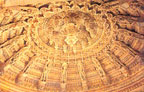
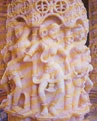
station in Rajasthan, Mt.Abu is more than a summer retreat. Its stunning array
of exquisite Dilwara Jain temples, dating back 11th - 13th centuries, make it a
popular pilgrimage center.
Places of interest & Prime Sites:-
Nakki Lake, Dilwara Temples, Sunset Point, Honeymoon Point
Excursions:- Trevor's Tank
(5 Kms), Achalgarh Fort (8 Kms), Guru Shikhar (15 Kms)
back to top
email for more details
|